
The place: the edge of the Sundarbans
Satkhira is a district of the far southwest of Bangladesh, with roughly 2.2 million people at the 2022 census.18 It borders India, and about a third of its southern land lies within the Sundarbans, the largest mangrove forest in the world. Rivers thread through it and meet the Bay of Bengal, which is why the land is beautiful, fertile and fragile at the same time.
Tala is one of the upazilas of Satkhira, and Gonali is one of its many small villages.
Water and salt
In a land of rivers, safe drinking water is surprisingly scarce. Along the coast, salt, arsenic and iron are the main reasons people cannot drink from their local sources.8 Studies in Tala have found high salinity in deeper aquifers, up to several times recommended levels.9 Arsenic from the natural geology is a further danger for coastal populations.10 Climate change and sea-level rise are expected to make this worse.13
What water does to the body
You cannot see arsenic. About 20 million people in Bangladesh drink water above the national arsenic limit.14 Salt does its own, quieter damage: a study in coastal Dacope found that pregnant women whose drinking water had the highest sodium had about 4.6 times the odds of pre-eclampsia, a dangerous rise in blood pressure, compared with those whose water was least salty. Women who drank rainwater were at lower risk than those who used tube wells.15
Storms
When Cyclone Aila struck in May 2009, the embankments that protect Satkhira collapsed, and the sea poured across fields, gardens and fishponds. More than a decade later, some of the wounds had still not healed.12
Too much water
Tala has the opposite problem too. Silt has choked the Kobadak River and the drains that should carry the monsoon away, and waterlogging keeps fields and homes under water for weeks. Reports describe hundreds of thousands of people in the Kobadak basin cut off for about two months in bad years, with crops and shrimp enclosures drowned.16
Land and livelihood
Salt has taken over large areas of farmland in Satkhira, and rice fields and freshwater ponds have given way to shrimp enclosures. Reporting describes farmers who would like to return to rice, but whose land is now too salty.11 For families who depend on daily wage labour, as most in Gonali do, a failed harvest or a flooded field means work found one morning and lost the next.
Homes and health
Most homes in Gonali are made of mud or tin, with little sanitation. Medical help is far away. Waterborne illness is common, and flooding and heavy rain spread contamination into shallow wells.22
Children
Children carry the weight of all of this: stomach illness, missed school, and the pressure to work. Yet the change is visible too. Where a school, a meal and clean water arrive, attendance rises, illness falls and children begin to talk about becoming teachers and doctors.
Children at work
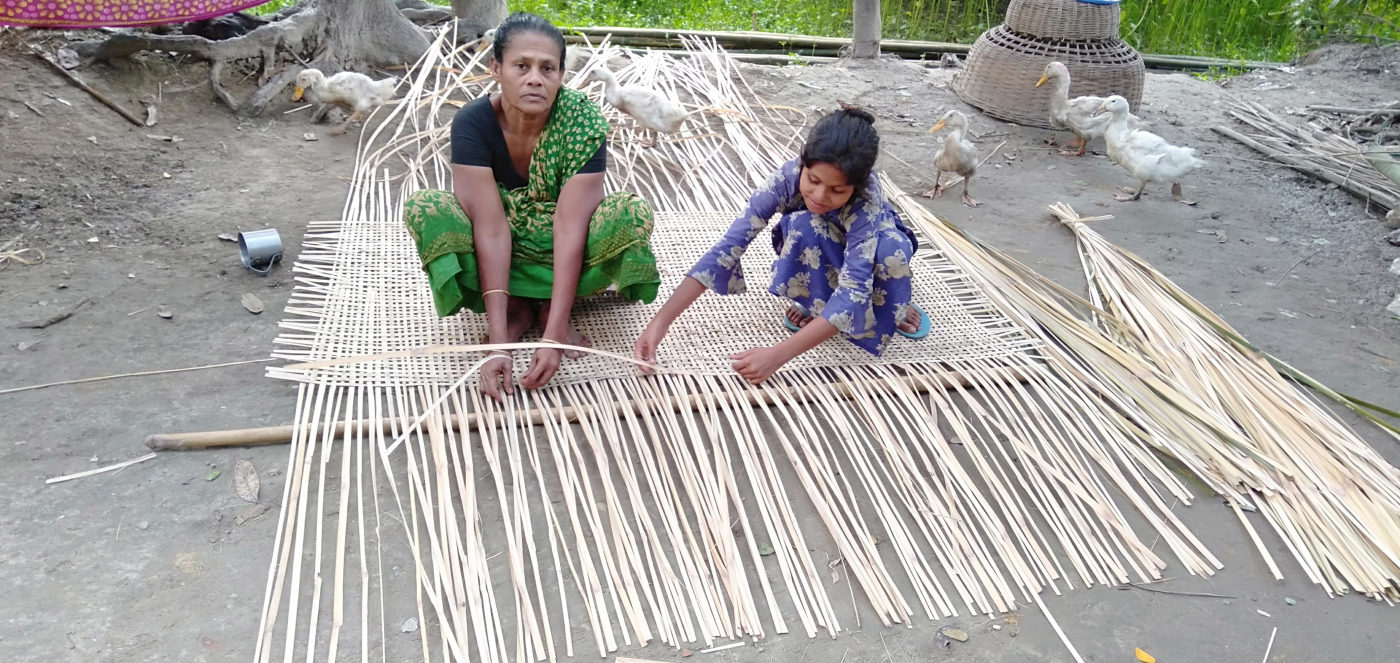
About one in eleven children in Bangladesh between five and seventeen works, some 3.5 million children, and more than a million of them in hazardous work.19 In Gonali the work is smaller and closer to home: splitting bamboo and weaving mats beside a parent. It is a reason why a school, and a school meal, matter so much.
Read what this looks like in our stories: Clean Water, Brighter Futures and From Darkness to Light.